
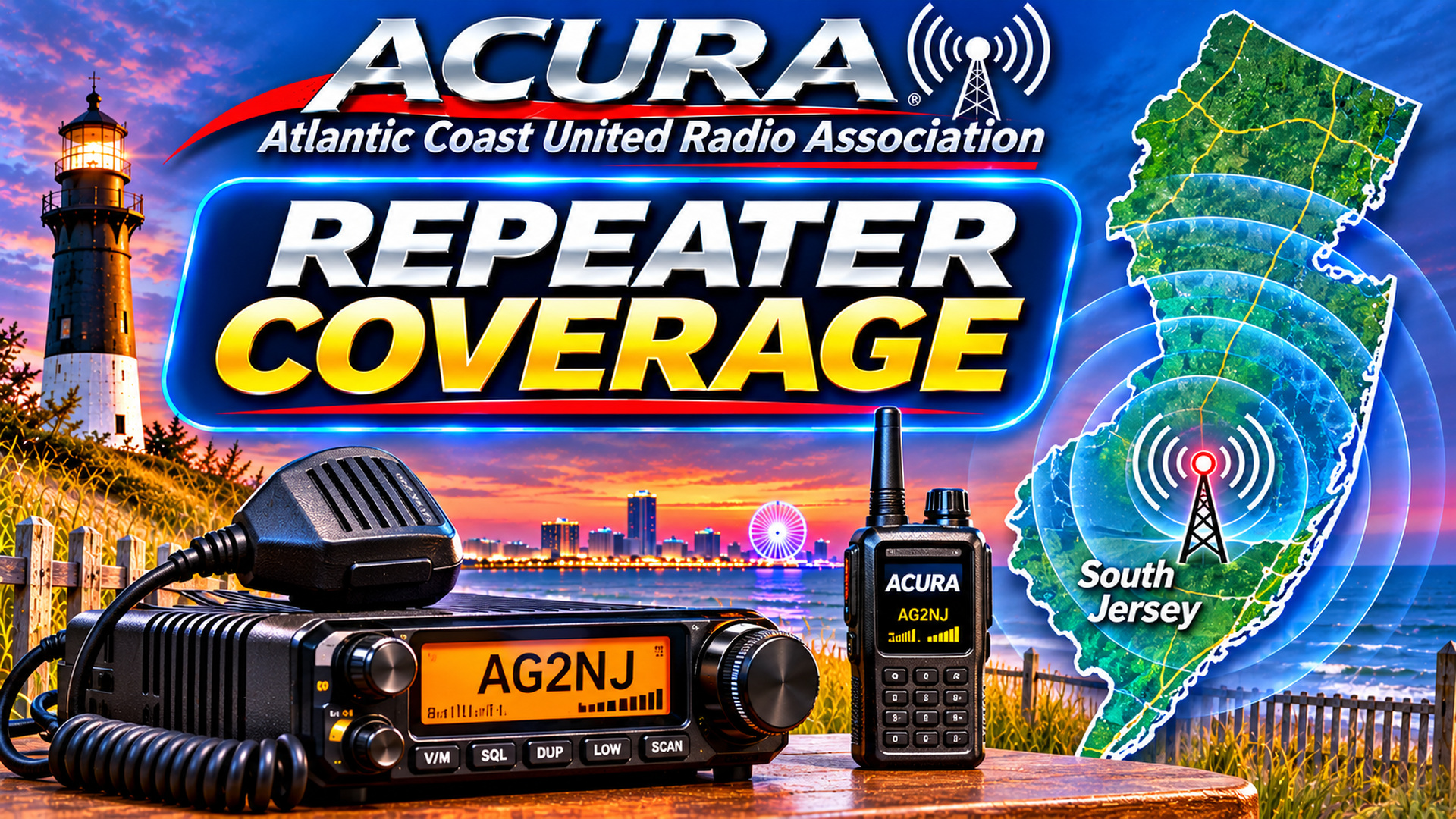
Looking for South Jersey ham radio repeaters? You are in the right place. The Atlantic Coast United Radio Association (ACURA) runs a linked repeater system that covers much of Atlantic County. In fact, one transmission on any of our machines can be heard on all of them at once.
This guide lists our frequencies and PL tones. It also explains how far each repeater reaches, how to program your radio, and when to join our weekly net. Whether you are a brand new Technician or a seasoned operator, we hope to hear you on the air soon.
South Jersey Ham Radio Repeaters at a Glance
Here is a quick reference for every ACURA repeater. Save it, print it, or keep it handy while you program your radio.
| Band | Frequency | PL Tone | General Area | AllStar Node |
|---|---|---|---|---|
| 2 meters | 147.165 MHz | 91.5 Hz | Egg Harbor City area | 46231 |
| 70 cm | 445.875 MHz | 85.4 Hz | Atlantic City | 463861 |
| 1.25 meters | 224.240 MHz | 100.0 Hz | Galloway Township | 44294 |
| 6 meters | 52.525 MHz simplex | None | Linked via AllStar | 45251 |
| 6 meters (coming soon) | 53.390 MHz | 156.7 Hz | Egg Harbor Township / Galloway | TBA |
For live status, visit our Repeater Status page. It shows which machines are on the air right now.
How the Linked System Works
Each ACURA repeater stands on its own. Even so, all of them are tied together through AllStar Link. So when you key up on 2 meters, your signal also goes out on 70 cm, 1.25 meters, and our other linked ports.
This setup gives you more reach than any single repeater could offer. For example, a mobile station near Hammonton can talk with a handheld user on the boardwalk in Atlantic City. As a result, the system feels like one big repeater across the county.
In general, our antennas sit roughly 170 to 300 feet above the ground. Because of that height, coverage is strong. Typically, a handheld works well within about 12 to 16 miles. Meanwhile, a mobile radio with a roof antenna can often reach 22 to 28 miles.
To see the details, check our Repeater Coverage Maps show estimated strong and fringe zones for each band. You can switch between handheld and mobile views, too.
How to Program South Jersey Ham Radio Repeaters
Programming a repeater for the first time can feel tricky. Still, the steps are the same on almost every radio.
- Set your radio to VFO (frequency) mode.
- Enter the repeater frequency from the table above.
- Check the offset. Most radios apply the standard offset for each band on their own.
- Next, turn on the transmit tone (often labeled CTCSS, TONE, or ENC).
- Set the tone to match the repeater, such as 91.5 Hz for 147.165.
- Finally, save the setting to a memory channel and give it a name like ACURA 2M.
Also, many hams use free software called CHIRP. It lets you program your radio from a computer with a cable. Better yet, you can load a whole list of channels at once. You can download CHIRP for free for Windows, Mac, or Linux.
If you get stuck, bring your radio to a club meeting. ACURA meets on the 4th Tuesday of every month at 6:30 PM at Holy Spirit High School, 500 S. New Road, Absecon, NJ. Our members are always happy to help program it with you.
Join the Thursday Night Net
First of all, every Thursday at 7:00 PM Eastern, ACURA holds a weekly net on the linked system. In short, a net is a scheduled on-air meeting. The net control station calls for check-ins, and each station takes a turn.
New to nets? Read our guide on how ham radio nets work first. Then follow along live on our Net Check-In Board, which shows each check-in as it happens.
In addition, there is a Monday night AUXCOMM and SKYWARN net at 8:00 PM. That net runs on both the ACURA and SCARA repeaters. It is a great way to practice emergency and weather reporting skills.
Out of Range? Use EchoLink or AllStar
However, you do not have to be in South Jersey to use our repeaters. Our EchoLink node is AG2NJ-R, node 447979. With the free EchoLink app, you can connect from a phone or computer anywhere in the world.
Keep in mind that EchoLink checks your license before your first connection. So sign up a day or two ahead of time.
Similarly, if you run your own AllStar node, you can link to us directly. Just use the node numbers listed in the table above.
Repeater Etiquette Basics
After all, good habits make the repeater better for everyone. Here are a few simple rules to follow:
- Listen first before you transmit.
- Give your call sign when you start, then at least every 10 minutes, and again when you finish.
- Pause a second or two between transmissions so others can break in.
- Keep transmissions short, since the repeater has a timeout timer.
- Always give way to emergency traffic.
Above all, be friendly. Many of our members first got on the air through a simple hello on the repeater.
6 Meters Is Coming Soon
Meanwhile, ACURA is also building a full 6 meter repeater on 53.390 MHz with a 156.7 Hz tone. It will use a split-site design, with the transmitter and receiver at separate locations. Until then, you can use 52.525 MHz simplex, which is linked through AllStar node 45251.
Of course, we will post an update here once the 6 meter machine is on the air.
Other South Jersey Ham Radio Repeaters
Of course, ACURA is one of several clubs that keep repeaters running in the region. For a complete list of other South Jersey ham radio repeaters, check RepeaterBook. It covers repeaters by county, band, and mode.
Likewise, local clubs often share their own repeater lists. Visiting a few nets is a good way to learn which machines are busiest in your area.
Not Licensed Yet? Start Here
Before you transmit on these repeaters, you need an FCC amateur radio license. Fortunately, the entry-level Technician exam is easier than most people think. It has 35 multiple-choice questions, and there is no Morse code test.
First, try our free FCC Practice Exam. Next, check the VE Testing Schedule for our next session. Finally, visit the New Hams page for tips on choosing your first radio.
In the end, we would love to welcome you to the ACURA linked repeaters. See you on the air!
Leave a Reply