
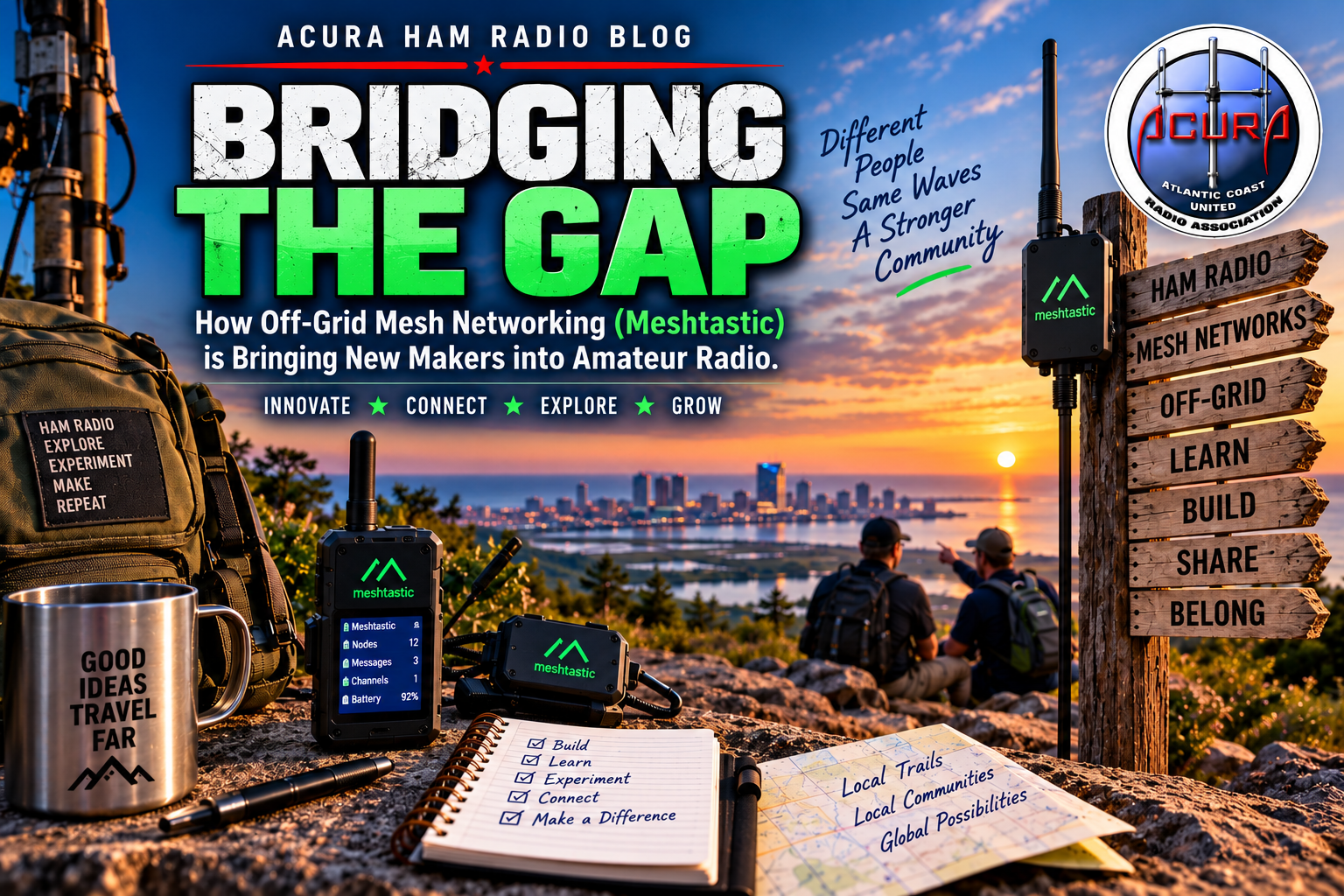
Something interesting is happening at the edges of amateur radio. A growing number of people are buying small, battery-powered radios and soldering on antennas. They climb onto rooftops to improve coverage, and they argue online about takeoff angle and path loss. Almost none of them hold an amateur radio license. In fact, they found their way in through Meshtastic, an open-source off-grid mesh networking project built on low-power LoRa radios. For a hobby that has spent three decades worrying about where the next generation of operators will come from, this deserves our attention rather than our suspicion.
What Meshtastic Actually Is
Specifically, Meshtastic is free, open-source firmware that turns an inexpensive LoRa development board into a node on a self-healing mesh network. LoRa — short for Long Range — is a spread-spectrum modulation scheme designed to trade data rate for sensitivity. In short, it is astonishingly good at getting a very small amount of data a very long way on very little power.
A Meshtastic node pairs to your phone over Bluetooth. You type a text message in the app, the node transmits it, and every other node that hears it repeats it onward until the message reaches its destination. Notably, there is no cell tower, no internet connection, no subscription, and no central server. If half the nodes disappear, the surviving ones simply find another path. That is the “mesh” in mesh networking, and it is the same store-and-forward thinking that has powered packet radio and APRS for decades.
In North America, Meshtastic operates in the 915 MHz ISM band. Meanwhile, in Europe it uses 868 MHz, and 433 MHz is common in other regions. Individual hops typically run one to ten miles depending on terrain and antenna placement, and clean line-of-sight paths — rooftop to rooftop, or hilltop to hilltop — can stretch well past twenty miles. So string enough nodes together, and a county-wide off-grid text network appears without anyone owning infrastructure.
Why It Reaches People Amateur Radio Has Been Missing
Here is the uncomfortable part, and it is worth saying plainly: Meshtastic requires no license. The ISM bands are open to anyone. First you buy a board, then you flash the firmware and install the app, and you are communicating in about fifteen minutes.
Compare that to the path we ask a newcomer to walk. Study a question pool. Find a test session. Pass the exam. Wait for your callsign. Buy a radio. Learn what offsets and CTCSS tones are. Find a repeater that is actually active. Work up the nerve to key the mic. Only then, after weeks of effort, do you get the payoff.
There is a well-known argument in the hobby that we have the learning curve backwards — that you do not teach someone to fish by starting with the molecular structure of water. You hand them a rod. Meshtastic hands people the rod. The theory comes later, and when it comes, they actively want it.
The hardware helps too. Capable starter nodes include the Heltec WiFi LoRa 32 V3, the LILYGO T-Beam, and the RAK WisBlock. Each one costs about as much as a nice dinner out rather than a car payment. That price point invites experimentation. Nobody agonizes over bricking a thirty-dollar board.
The Overlap Hiding in Plain Sight
Here is the detail that turns Meshtastic from a parallel hobby into a genuine on-ramp to amateur radio, and most mesh users discover it within a few months.
In the United States, the 902–928 MHz ISM band sits squarely inside the amateur 33 centimeter allocation. In other words, the unlicensed hobbyist and the licensed amateur are, quite literally, neighbors on the same stretch of spectrum. The moment a mesh operator learns that, a door opens: with an amateur license, the same hardware and the same band can be operated under Part 97 instead of Part 15.
That change comes with real advantages and real obligations. On the plus side, amateur rules allow substantially more transmit power and far more antenna freedom than Part 15 permits. For a mode already designed to squeeze distance out of milliwatts, that is a significant upgrade. On the obligation side, Part 97 prohibits transmissions encoded to obscure their meaning. So operating a mesh under your license means clearing the pre-shared key and running open. You must also identify with your callsign. Usually, operators handle that by setting their callsign as the node’s long name.
Those tradeoffs are not footnotes. Above all, they are a working introduction to the entire philosophy of amateur radio: open communications, self-policing, shared spectrum, and operator responsibility. A mesh hobbyist who reads up on why encryption is off-limits has just learned more about the character of the Amateur Radio Service than any multiple-choice question could teach.
What Mesh Builders Learn Without Realizing It
Spend a few weeks trying to improve a mesh node and you will teach yourself, by necessity, most of a Technician class syllabus:
- Antennas matter more than power. Nothing teaches this faster than swapping a stubby rubber duck for a proper vertical and watching your node count double.
- Height is everything above 900 MHz. Mesh users rediscover line-of-sight propagation and Fresnel zones the hard way, one disappointing backyard test at a time.
- SWR and feedline loss are real. At 915 MHz, cheap coax punishes you quickly, and the lesson sticks.
- Coverage is a community project. One well-placed node on a tall building helps everyone — which is exactly the logic behind every repeater our hobby has ever built.
- Infrastructure fails. The appeal of off-grid communications is that it keeps working when the cell network does not — the same instinct that drives amateur emergency communications.
These are our people. Actually, they are doing RF experimentation, coverage planning, and emergency preparedness. They simply arrived by a different road.
Where Meshtastic Stops and Amateur Radio Begins
None of this means mesh networking replaces amateur radio, and pretending otherwise does newcomers no favors. Indeed, Meshtastic is deliberately narrow. It moves short text messages and position reports at very low data rates. Voice lies outside its design. So do images. It has no path across an ocean, no HF propagation to chase, no satellites to work, no contests, no moonbounce, no digital voice networks, no emergency traffic handling at scale.
The honest framing — the one that actually recruits — is this: Meshtastic is a superb answer to “can I talk to my neighborhood without infrastructure?” Amateur radio is the answer to nearly every question that comes after it. A mesh network covers your town. A license covers the planet.
Some hams have started calling Meshtastic “APRS 2.0” — more efficient, more accessible, and license-free. That comparison is a compliment to both sides, and it points at something important: the mesh crowd is solving problems our hobby has been solving for forty years, using tools we would recognize instantly.
What This Means for ACURA and Clubs Like Ours
The temptation is to dismiss it. “That is not real ham radio.” That response guarantees we lose people who were already halfway to a license and did not know it.
The better response is hospitality. A few concrete ideas the Atlantic Coast United Radio Association and clubs across South Jersey can act on:
- Invite mesh operators to meetings. They are radio experimenters. Treat them as such and they will feel at home.
- Run a build night. Hand people a board, help them flash firmware, get a node on the air, and let the questions come naturally.
- Put a node on the club repeater site. Height we already have is coverage they cannot easily get — and it makes the club visibly useful to a new audience.
- Demonstrate the upgrade. Show the same band under Part 97: more power, better antennas, open traffic, callsign ID. Make the license the obvious next step rather than a hurdle.
- Fold it into emergency communications planning. Off-grid text messaging is a genuine capability when the grid and the cell network are down along the Atlantic coast.
- Offer the license class right there. Interest is perishable. Catch it while the soldering iron is still warm.
Getting Started With Meshtastic This Weekend
If you want to try it yourself — and every ham should, if only to speak the language — the barrier is low:
- Pick up a LoRa board built for the 915 MHz North American band. The Heltec WiFi LoRa 32 V3 is the usual recommendation for beginners; the LILYGO T-Beam adds GPS, and the T-Deck adds a keyboard for standalone use.
- Flash the Meshtastic firmware using the project’s web-based installer. No toolchain, no command line.
- Install the Meshtastic app on your phone and pair over Bluetooth.
- Replace the supplied antenna with something better as soon as you can, and get it as high and as clear as possible.
- Check whether a regional mesh already exists near you, and join it rather than starting from scratch.
Then, once you have felt how much distance a fraction of a watt can cover, take a look at what the same spectrum allows with a license behind it.
Frequently Asked Questions
Do I need a ham radio license to use Meshtastic?
No. In the United States, Meshtastic runs in the unlicensed 915 MHz ISM band under Part 15, and no amateur radio license or exam is required for personal use.
What can a licensed amateur do that an unlicensed mesh user cannot?
Operating under Part 97 on the overlapping 33 centimeter amateur band allows significantly higher transmit power and greater antenna latitude. In exchange, the channel must run unencrypted and the operator must identify with a callsign.
How far does a Meshtastic node actually reach?
A single hop commonly covers one to ten miles depending on terrain, obstructions, and antenna height. Clear line-of-sight paths between elevated sites can exceed twenty miles, and the mesh extends far beyond any single hop by relaying through other nodes.
Is Meshtastic useful for emergency communications?
Yes, within its limits. It carries short text and position data without any infrastructure, which makes it valuable when cell service and power are out. It does not replace voice nets, HF traffic handling, or formal amateur emergency communications, but it complements them well.
The Bigger Picture
Amateur radio has never been one hobby. It has been a rolling series of them — spark, AM, SSB, FM repeaters, packet, satellites, digital modes, software-defined radio. Each wave arrived with newcomers who were fascinated by the new thing and indifferent to the old, and each wave was absorbed and made the service stronger.
Off-grid mesh networking is the current wave. The people riding it are curious, technical, hands-on, and already invested in radio propagation whether or not they use that phrase. They have built themselves a on-ramp to our hobby. The only question is whether we are standing at the top of it with a handshake and a license class, or with our arms folded.
If mesh networking, software-defined radio, or off-grid communications interest you, ACURA would like to hear from you. Try the club’s live SDR receiver to hear what is on the air right now, then get in touch — licensed or not, experienced or curious, you are welcome here.
Leave a Reply