
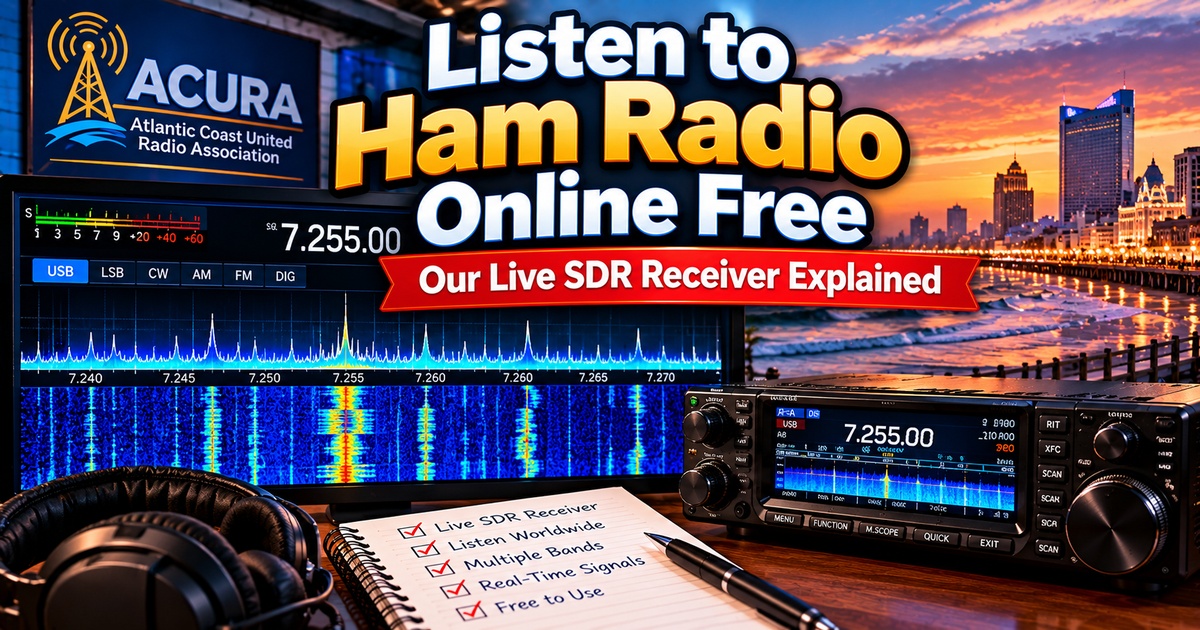
You do not need a license or a radio to start exploring the airwaves. In fact, you can listen to ham radio online for free tonight, using nothing more than a web browser. All it takes is a software-defined radio, or SDR, connected to the internet.
The Atlantic Coast United Radio Association (ACURA) runs one for the public. This post explains what an SDR is in plain English, what you can hear, and how to use our live SDR Receiver. It is one of the easiest ways for South Jersey residents to discover what ham radio sounds like.
What Is an SDR?
SDR stands for software-defined radio. A traditional radio uses physical circuits, knobs and filters to pick out one station. An SDR, on the other hand, does most of that work in software.
Here is a simple way to picture it. The SDR’s antenna and hardware capture a wide slice of the radio spectrum all at once. Then, a computer program decides which part of that slice you want to hear. Because the tuning happens in software, the radio can be controlled from anywhere, including a web page.
That is why online receivers exist. Someone sets up an SDR with a good antenna and connects it to the internet. As a result, listeners around the world can tune it from their own screens.
Why SDRs Changed the Hobby
SDR technology used to be expensive and experimental. Today, it is everywhere. Many modern ham transceivers are SDRs inside, and small USB receivers cost less than a dinner out. Meanwhile, online receivers have opened the hobby to people who have never touched a radio.
Why Listen to Ham Radio Online?
There are plenty of good reasons to tune an online receiver.
- You are curious. You want to hear what ham radio is like before getting licensed.
- You are studying. Hearing real contacts makes the Technician exam material click.
- You live in an apartment. Antenna restrictions keep you off the air at home.
- You are away from your station. Members can check band conditions from work or while traveling.
- You follow emergencies. During hurricanes, you can monitor nets that pass vital information.
Listening is also how many great operators learned. Hams call it “reading the mail.” By listening first, you pick up the rhythm, the etiquette and the vocabulary of the hobby.
Meet the ACURA SDR Receiver
The ACURA SDR Receiver is a fully working HF receiver that you control from your browser. It tunes from 0 to 30 MHz. That range covers the AM broadcast band plus every amateur band from 160 meters through 10 meters.
The receiver’s antennas sit in the Pocono Mountains of Pennsylvania. That high location gives it excellent reach up and down the East Coast. So, you will hear stations from New England to the Carolinas, and often far beyond.
A Real Radio, Not a Recording
Everything on the page works like a real radio. You can turn the main dial, use the plus and minus tuning buttons, or click the frequency display and type an exact frequency. You can also change modes and adjust receiver settings, just as you would on a radio at home.
Station Tags Help You Know What You Hear
New listeners often wonder who they are hearing. To help, our receiver shows a station tag badge under the frequency display. It automatically names well-known stations and nets when you land on their frequencies. For example, it identifies WWV and WWVH time signals, the Hurricane Watch Net, ECARS, and many AM broadcast stations.
A Live View of Atlantic City
Most online receivers show a waterfall display. Ours does something different. Instead, it features a live video feed of the Atlantic City Boardwalk. It is a fun local touch while you scan the bands.
How to Listen to Ham Radio Online: Quick Start
Ready to try it? Follow these simple steps.
- Open the SDR Receiver page on a computer, tablet or phone.
- Turn up your device’s volume and press play if your browser asks.
- Type 10.000 MHz into the frequency display to hear the WWV time signal.
- Next, choose LSB mode and try 7.200 MHz in the evening to hear 40-meter conversations.
- Then, switch to USB and tune around 14.200 MHz during the day for long-distance 20-meter contacts.
A quick note on modes helps here. Ham voice signals below 10 MHz usually use lower sideband, or LSB. Above 10 MHz, they usually use upper sideband, or USB. If a voice sounds like a duck, switch modes or tune slowly until it sounds natural.
What You Might Hear
The HF bands change all day long. That is part of the fun.
During the day, the higher bands like 20, 15 and 10 meters often open to distant states and countries. After dark, however, the lower bands such as 40, 80 and 160 meters come alive. You may hear casual conversations, organized nets, contests with rapid-fire exchanges, and Morse code. You might also catch international broadcasters and familiar AM stations.
Conditions depend heavily on the sun. To see what the bands are doing right now, visit our DX propagation page.
Tips to Listen to Ham Radio Online Like a Pro
A few habits will make your listening sessions far more rewarding.
First, tune slowly. Signals are narrow, and it is easy to skip right past a weak station. Second, use headphones. They make faint voices and Morse code much easier to copy. Third, keep a simple log. Write down the time, frequency and call signs you hear. Over a few weeks, you will notice patterns in when each band opens.
Also, be patient with weak signals. Conditions can change within minutes, so a quiet band may come alive shortly. Finally, look up the call signs you hear. Free online databases often show where a station is located, which turns every contact into a small geography lesson.
More Ways to Listen to Ham Radio Online: WebSDR
ACURA’s receiver is only one of many. If you want another listening point, our WebSDR page links to several excellent East Coast receivers. Comparing them is an eye-opening lesson in how location and antennas affect what you hear.
From Listening to Talking
Many people listen for a few weeks and then decide they want to talk back. That is exactly how the hobby grows. Fortunately, the next step is easier than you might think.
To transmit, you need an FCC amateur radio license. The entry-level Technician exam has 35 multiple-choice questions, and ACURA’s Volunteer Examiners give it right here in Galloway Township. Our guide on how to get your ham radio license in New Jersey walks you through every step. After that, our guide to the best beginner ham radios will help you pick your first rig.
Listen to Ham Radio Online, Then Join Us
The easiest way to listen to ham radio online is to open our SDR Receiver and start tuning. It is free, it works on most devices, and it puts the whole HF spectrum at your fingertips.
When you are ready for more, join the people behind it. ACURA welcomes listeners, students and new hams from across South Jersey and Atlantic County. Check out our testing schedule, join our Thursday night net at 7:00 pm on the ACURA repeaters, or contact the club with your questions. We would love to hear you on the air soon.
Leave a Reply