
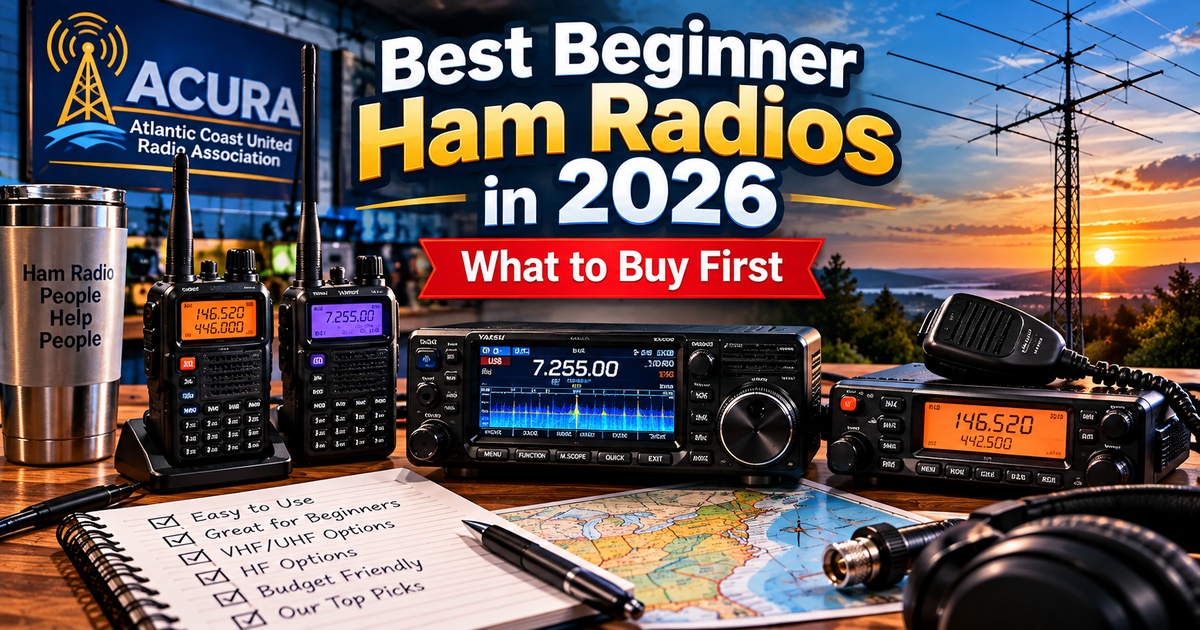
Picking your first beginner ham radio can feel harder than passing the license exam. Catalogs are packed with model numbers, and online forums argue about everything. However, the right first radio is usually simpler and cheaper than people expect.
At the Atlantic Coast United Radio Association (ACURA), we meet new operators from across South Jersey and Atlantic County every month. Many of them ask the same question right after they pass: what should I buy first? This guide shares the answer our members give most often. It also explains why the “best” radio depends on what you actually want to do.
Choosing a Beginner Ham Radio Starts With Your Goals
Before you spend a dollar, think about how you plan to use the radio. A beginner ham radio for chatting on local repeaters is very different from a radio for talking to Europe. So, ask yourself a few honest questions first.
- Do you mainly want to talk with local hams around Atlantic County?
- Will you operate from your car during your commute?
- Are you hoping to make long-distance contacts across the country or overseas?
- Do you want a radio ready for storms and power outages?
Most new Technician licensees start local. That is because the Technician license gives you full privileges on the VHF and UHF bands, where repeaters live. As a result, a handheld or a mobile radio covers almost everything a new Technician will do in the first year.
Tier 1: A Handheld Beginner Ham Radio
For most people, the first radio should be a dual-band handheld, often called an HT. It covers the 2-meter and 70-centimeter bands. Those are the bands used by ACURA’s linked repeaters and most other South Jersey repeaters.
Budget Options
Inexpensive Chinese handhelds from brands like Baofeng and Quansheng sell for roughly $25 to $70. They work, and they are a low-risk way to get on the air. That said, they come with trade-offs. Programming them from the keypad is confusing, and their receivers can struggle near strong signals. Still, plenty of our members got their start with one.
A Step Up
For a little more money, a name-brand handheld is easier to live with. For example, the Yaesu FT-65R typically sells for around $110, and the compact Yaesu FT-4XR is in a similar range. These radios are rugged, simple to program, and well supported. In addition, they hold their value if you decide to upgrade later.
Beginner Ham Radio Advice From Our Members
Experienced members share a few tips with almost every new ham.
- Replace the stock antenna. A better antenna often helps more than extra power.
- Buy the programming cable. Free software such as CHIRP makes loading repeaters far easier than the keypad.
- Get a spare battery or a battery eliminator. Nets and events can run longer than you think.
- Learn the local repeaters first. Our 147.165 MHz repeater in Egg Harbor uses a 91.5 Hz tone, and it links to the rest of the ACURA system.
A handheld’s range is limited, of course. Indoors, from a low spot, it may not reach a repeater 15 miles away. That is not a flaw in the radio. Instead, it is simply the physics of low power and a small antenna.
Tier 2: A Mid-Range Mobile Radio
Once you have used a handheld for a while, a mobile radio is the most common next step. Mobile radios mount in a car or sit on a desk with a power supply. They usually put out 25 to 50 watts, compared with 5 watts from a typical handheld. Name-brand dual-band mobiles generally cost about $200 to $450.
This upgrade makes a dramatic difference here in South Jersey. Our area is flat, so antenna height matters a great deal. A mobile radio with a roof-mounted antenna can reach repeaters that a handheld cannot. Similarly, a mobile radio at home with an outdoor antenna turns you into a dependable station for nets and emergencies.
What to Look For in a Mobile
- Dual-band coverage of 2 meters and 70 centimeters.
- A detachable faceplate so the radio body can hide under a seat.
- Easy programming with a cable and computer software.
- A good power supply if you plan to use it at home. A 30-amp supply leaves room to grow.
Some mobile radios also offer digital modes such as DMR, D-STAR or System Fusion. These are fun to explore. However, a new ham does not need digital on day one. Plain FM works on almost every repeater in Atlantic County.
Tier 3: A Starter HF Radio
HF, or high frequency, is where ham radio goes worldwide. With an HF radio and a simple wire antenna, you can talk to other states and other continents. Technicians have limited HF privileges, mostly on 10 meters. Therefore, many hams buy their first HF rig after upgrading to the General license.
Budget and Mainstream Choices
A few radios stand out for new HF operators in 2026.
- Xiegu G90. A 20-watt radio with a built-in antenna tuner, usually under $500. It is a great value for learning.
- Yaesu FT-891. A compact 100-watt radio at about $820. It works well in a car, at home, or at Field Day.
- Icom IC-7300. Often called the default first HF radio, at roughly $1,200. Its touch screen and waterfall display make tuning easy to learn.
Prices shift often, so check a few authorized dealers before buying any beginner ham radio. For independent reviews, the ARRL publishes product reviews in its members’ magazine. In addition, remember the antenna, feed line, power supply and grounding. Those can add a few hundred dollars to the total cost.
Try Before You Buy
You can hear what HF sounds like before buying anything. ACURA runs a free online HF receiver on our SDR Receiver page. It tunes from 0 to 30 MHz, so you can listen to the ham bands right from your browser. Spend an evening tuning around, and you will quickly learn which bands interest you most.
Common Beginner Ham Radio Mistakes to Avoid
New hams tend to make the same few mistakes. Fortunately, each one is easy to avoid.
First, buying the most expensive radio right away rarely pays off. You do not yet know which part of the hobby you will love. Second, many people ignore the antenna. A cheap radio on a good antenna usually beats an expensive radio on a poor one. Third, avoid buying gear that transmits outside the ham bands without understanding the rules. Your license covers amateur frequencies only.
Finally, do not buy alone. A local club can save you money, time and frustration.
Buying Used Gear in South Jersey
Used radios are a smart way to stretch a budget. Hamfests, club swap tables and online listings often have well-kept gear at fair prices. Even so, a used radio can hide problems. Ask the seller to demonstrate it on the air, and bring an experienced friend if you can.
ACURA members also post gear on our Buy, Sell and Trade page. It is a good place to find local equipment from people you can meet face to face.
Let ACURA Help You Choose a Beginner Ham Radio
The best beginner ham radio is the one you will actually use. For most people, that means a dependable handheld first, then a mobile radio, and eventually HF. Along the way, the advice of experienced operators is worth more than any product review.
That is where ACURA comes in. Our members are happy to show you their radios, help you program a new handheld, and explain what to buy next. You can also practice on the air during our weekly club net every Thursday at 7:00 pm Eastern on any of our linked repeaters. If you are new to nets, read our guide on how ham radio nets work first.
Not licensed yet? ACURA’s Volunteer Examiner team holds exam sessions in Galloway Township. Visit our testing schedule to find the next date. Then, get in touch with the club. We would love to help you get on the air in South Jersey.
Leave a Reply