
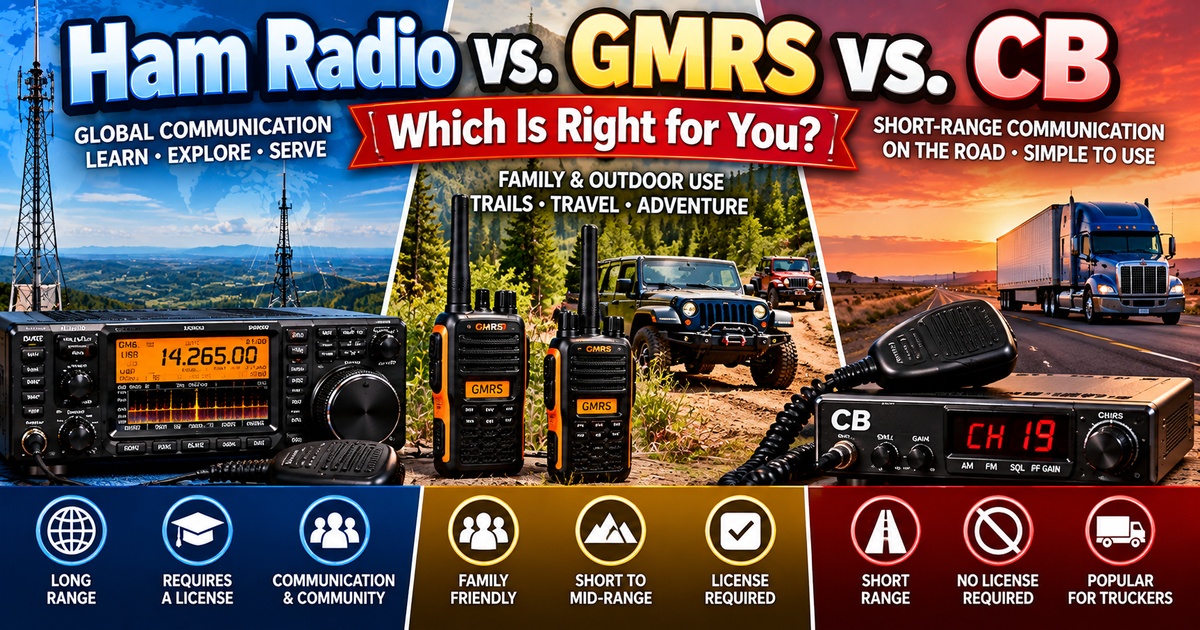
Families, campers, truckers and preppers all eventually ask the same question. Which two-way radio should I get? The three most common answers are CB, GMRS and ham radio. Each one has real strengths. However, they differ a lot in licensing, range, cost and what you can do with them. In fact, ham radio vs GMRS is the comparison we hear about most at club meetings.
This guide compares ham radio vs GMRS vs CB in plain English. We will look at each service, then lay them side by side. Finally, we will explain why so many people in South Jersey decide that ham radio is worth the extra step.
CB Radio: No License, Short Range
Citizens Band, or CB, has been around since the 1940s and peaked in popularity in the 1970s. It uses 40 channels near 27 MHz. Best of all, no license is required. You can buy a radio, install it and start talking today.
CB has firm limits, though. The FCC caps power at 4 watts on AM and 12 watts on single sideband. In practice, a typical mobile CB reaches a few miles, depending on the antenna and terrain. CB antennas are also physically large, because of the low frequency.
Who CB Suits Best
CB is still popular with truckers and off-road groups. It is also simple and cheap. A basic CB radio and antenna often cost $60 to $200. So, if you only need short-range chatter on the highway, CB is a reasonable choice.
GMRS: A License, But No Test
The General Mobile Radio Service, or GMRS, operates in the UHF band around 462 and 467 MHz. It shares some channels with FRS, the license-free “bubble pack” radios sold in stores.
GMRS requires an FCC license. Fortunately, there is no exam. You apply online, pay $35, and the license lasts ten years. Even better, one license covers your immediate family members.
What GMRS Can Do
GMRS allows up to 50 watts on its main channels, and it supports repeaters. As a result, a good GMRS mobile radio with a roof antenna can reach much farther than a handheld. Handhelds typically cover a few miles. With a repeater, though, coverage can stretch across a county.
GMRS radios are affordable, too. Handhelds run roughly $30 to $150, and mobiles usually sell for $150 to $350.
Who GMRS Suits Best
GMRS is great for families who want to stay in touch on trips, at the beach or around the neighborhood. It is simple to license, and kids can use the family license.
What About FRS Radios?
You have probably seen inexpensive walkie-talkies in big-box stores. Most of them are FRS, or Family Radio Service, radios. FRS needs no license at all. However, power is limited to 2 watts, and the antennas cannot be removed or upgraded. As a result, range is usually a mile or two in real use, despite the big numbers printed on the box.
FRS is perfect for kids at the park or a group at the beach. Still, it is not a serious emergency tool. Think of it as the starting point below GMRS.
Ham Radio, GMRS and CB Rules: A Quick Word
Every one of these services has FCC rules. Some radios sold online can transmit on frequencies they are not certified for. Using them that way can cause interference and lead to fines. So, buy radios certified for the service you plan to use. If you are unsure, ask an experienced operator before you transmit.
Ham Radio: An Exam, and a Whole World Opens Up
Amateur radio, or ham radio, is the most capable of the three. It requires an FCC license, and that means passing an exam. The entry-level Technician test has 35 multiple-choice questions from a public question pool. Like GMRS, the license costs $35 and lasts ten years.
In exchange for that exam, hams get far more freedom. Hams can use bands from below 2 MHz up into the microwave range. Depending on license class, power can go up to 1,500 watts. Hams can also build and modify their own equipment, which other services do not allow.
What Ham Radio Can Do
The range of activities is enormous. Local repeaters cover whole regions, and linked systems tie repeaters together. For example, ACURA’s linked repeaters connect VHF, UHF, 220 MHz and 6 meters across Atlantic County. On HF, you can talk directly to other states and other continents with no infrastructure at all. Hams also use digital modes, satellites, mesh networks and internet linking like EchoLink.
Ham Radio vs GMRS vs CB: Side by Side
Here is a quick summary of the key differences.
- License. CB needs none. GMRS needs a $35 license with no test. Ham radio needs a $35 license and an exam.
- Who is covered. A GMRS license covers your immediate family. A ham license covers only you.
- Power. CB allows 4 to 12 watts. GMRS allows up to 50 watts. Ham radio allows up to 1,500 watts.
- Typical range. CB and GMRS handhelds reach a few miles. GMRS repeaters reach farther. Ham radio ranges from local to worldwide.
- Frequencies. CB has 40 channels. GMRS has 30 channels, 22 of them shared with FRS. Ham radio has wide bands from HF through microwave.
- Radio cost. All three can start well under $100, but quality gear costs more.
Ham Radio, GMRS or CB: Which Is Right for You?
The honest answer depends on your goals.
CB makes sense if you want zero paperwork and only need short-range talk on the road. GMRS fits better if your main goal is simple family communication and you do not want to take a test. Choose ham radio if you want range, flexibility, emergency capability and a community of skilled operators.
Many people also use more than one. For instance, a family might carry GMRS radios for the kids while a parent holds a ham license. That combination works very well.
The Case for Ham Radio Over GMRS and CB
We are a ham radio club, so we are a little biased. Even so, the case for amateur radio is strong.
First, the exam is easier than most people fear. Most of our new licensees pass after a few weeks of study using free tools. Second, the community is the real difference. Hams help each other, train together and serve during emergencies. That is why ham operators support SKYWARN storm spotting and emergency communications in Atlantic County.
Third, ham radio grows with you. You can start with a $30 handheld on a local repeater. Later, you can talk to Japan, bounce signals off satellites, or build your own antennas. Neither CB nor GMRS offers that path.
Finally, the cost is nearly identical to GMRS. Both licenses cost $35 for ten years. The only real difference is a few weeks of studying.
Choosing Between Ham Radio, GMRS and CB in South Jersey
If you are weighing ham radio vs GMRS vs CB, come talk with us. ACURA members are happy to show you what ham radio can do, and many of us use GMRS or CB as well.
When you are ready, follow our guide on how to get your ham radio license in New Jersey. Our Volunteer Examiners hold test sessions in Galloway Township, and the dates are on our testing schedule. In the meantime, you can listen to ham radio online for free, or browse our guide to the best beginner ham radios. Questions? Contact ACURA any time.
Leave a Reply