
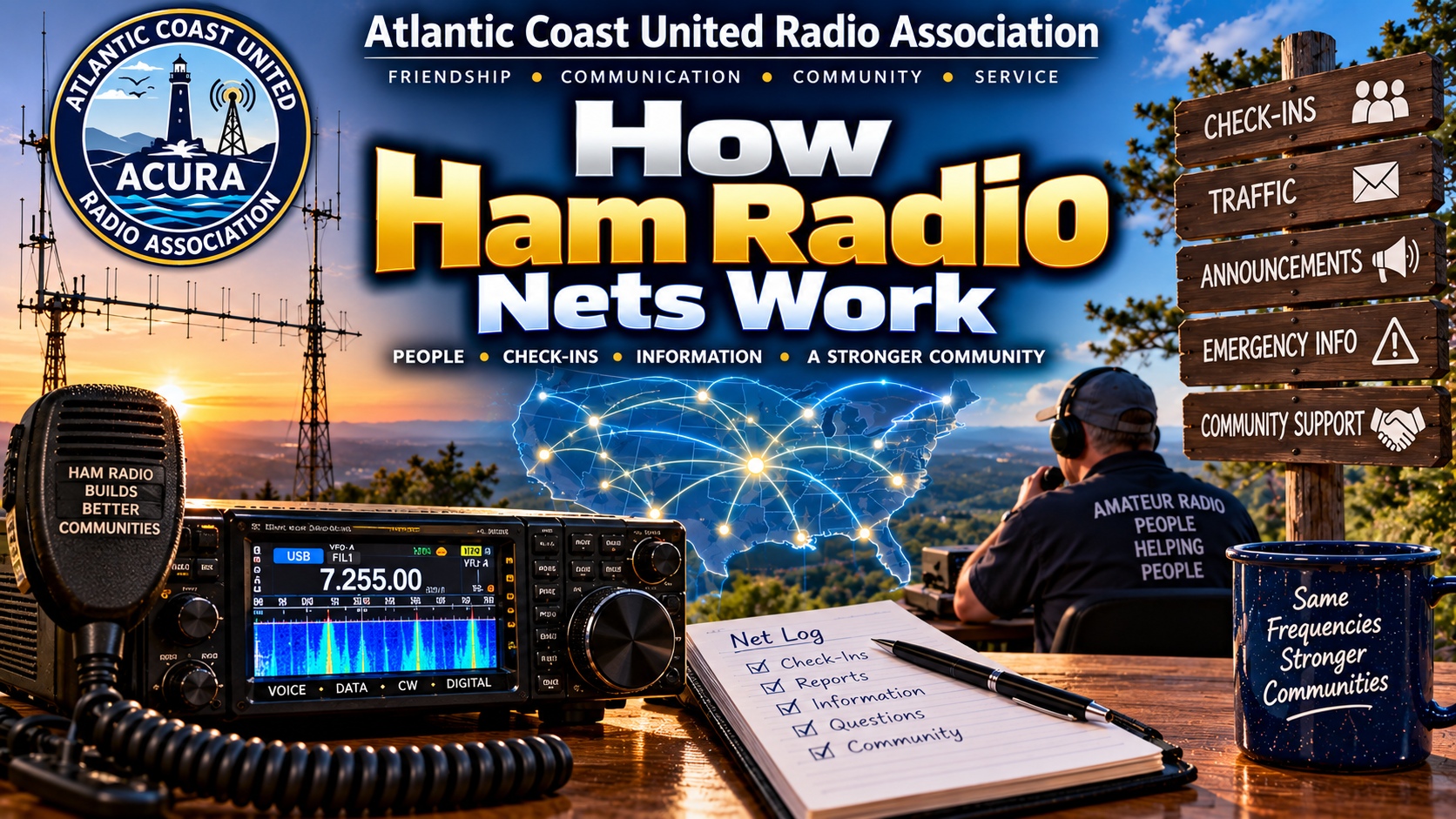
If you want to understand how ham radio nets work, you are asking the right question early. Nets are the friendliest way to start talking on the air, and a great many new operators make their first real contact on one.
From the outside a net sounds formal. You hear one voice directing traffic, stations waiting their turn, and a rhythm that seems to follow rules nobody wrote down. Those rules do exist, and they take about five minutes to learn.
This guide covers what a ham radio net is, who runs it, the main types you will hear, and exactly what to say when your turn arrives. At the end you will find ACURA’s own net schedule, so you can practice on a real one here in South Jersey.
What Is a Ham Radio Net?
A net is a scheduled on-air meeting. Operators gather on an agreed frequency at an agreed time, one station coordinates the gathering, and everybody takes turns speaking.
The word itself comes from “network.” Picture a conference call where the moderator keeps order so nobody talks over anybody else.
Nets run on repeaters, on simplex frequencies, on the HF bands, and over internet-linked systems such as EchoLink and AllStarLink. Some meet weekly, others meet nightly, and a few activate only when a storm threatens the coast.
Most ham radio nets last 30 to 60 minutes. You do not need to sign up, pay anything, or know a single regular. Checking in makes you part of it.
Directed Nets and Open Nets: Two Ways Ham Radio Nets Run
Ham radio nets fall into two broad styles, and telling them apart shapes how you behave on the air.
Directed nets
A directed net has a station in charge, called Net Control. That operator calls for check-ins, recognizes stations one at a time, and decides who transmits next. You speak when Net Control invites you, and not before. Emergency nets, traffic nets, and most club nets work this way.
Open nets
An open net, sometimes called a round table, runs more loosely. Stations pass the conversation around in a rough rotation, usually in the order they checked in. Someone still opens and closes the session, but the moderator interrupts far less often.
Listen for a minute and the style becomes obvious. When one voice keeps asking “any further check-ins?”, you are on a directed net.
Who Runs the Show: The Net Control Station
Net Control is the operator running the net. That station opens with a preamble, takes check-ins, keeps a written list, and gives every station a turn.
Good Net Control keeps things moving without rushing anyone. During an emergency the role turns serious: Net Control logs traffic, prioritizes urgent messages, and protects the frequency for the stations that need it most.
Clubs usually rotate the job among volunteers, which is how newer operators eventually learn it. Nobody expects you to run a net in your first month, though the skill is well worth building.
The Types of Ham Radio Nets You Will Hear
Club and social nets
These are the on-ramp for most people. A club net gathers members for announcements, gear talk, weekend plans, and ordinary conversation. Check-ins often take ten minutes, and a comment round follows.
Emergency and public service nets
ARES, the Amateur Radio Emergency Service, organizes volunteers who support agencies during storms, outages, and public events. AUXCOMM training prepares operators to work alongside emergency management professionals. Such nets drill weekly so the procedures feel automatic once conditions turn bad.
Traffic nets
Traffic nets move written messages, called radiograms, through the National Traffic System. Operators relay formatted messages station to station across the country without touching the internet. The format feels old-fashioned, yet it still delivers when nothing else does.
Weather and hurricane nets
SKYWARN volunteers report severe weather directly to the National Weather Service. Here in South Jersey, the Mount Holly forecast office relies on trained spotters for ground truth: hail size, wind damage, flooding, and funnel clouds.
On HF, the Hurricane Watch Net operates on 14.325 MHz and 7.268 MHz, depending on propagation. It activates any time a hurricane sits within 300 statute miles of a populated landmass, or whenever the National Hurricane Center asks for it. Station WX4NHC at the Hurricane Center collects those reports and fills gaps in the forecasters’ data.
No HF gear? The VoIP Hurricane Net gathers the same kind of reports over EchoLink, IRLP, and other digital links, so a VHF operator can still contribute.
Special interest and DX nets
Past the practical nets sit sessions for nearly every interest: satellites, QRP, antenna building, Morse code practice, and long-distance contacts. Several meet on HF and reach clear across oceans.
How Ham Radio Nets Work in Practice: Checking In, Step by Step
Here is the whole process, start to finish.
- Program the frequency and PL tone in advance. Fumbling with a radio while the net opens rattles anybody.
- Tune in five minutes early and just listen. Net Control will open the session with a short preamble.
- Wait for the call for check-ins. Net Control typically asks by area, by license class, or simply for anyone wishing to join.
- Pause a beat after the request, then give your call sign slowly using phonetics. “Kilo Delta 2 Alpha Bravo Charlie” beats a rushed “KD2ABC” every time.
- Add your first name and town when the net asks for them. Many nets want call sign, name, and location.
- Listen for Net Control to read your call sign back. Nobody acknowledged you? Wait for the next opening and try again.
- Say “no traffic” or “nothing for the net” if you have no announcements and want to keep it brief.
- Stick around until the net closes, or tell Net Control when you need to leave early.
What to Say When Your Turn Comes
Turns run shorter than beginners expect. Thirty to sixty seconds covers most of them comfortably.
A pattern that always works: greet the net, answer whatever question was asked, add one thing about your week or your station, then hand it back cleanly. “That is all from me, back to Net Control” does the job.
Feeling nervous? Jot three bullet points on paper before you key up. Reading from notes is perfectly legal, and nobody on the other end can tell.
Ham Radio Net Etiquette That Marks You as a Good Operator
- Wait a full second after the previous station unkeys before you transmit.
- Identify with your call sign rather than your first name or a nickname.
- Keep each transmission short so the repeater timer never cuts you off.
- Reserve the word “break” for genuinely urgent traffic, never for jumping the line.
- Leave politics, sales pitches, and grievances off the air.
- Skip a net rather than fight a weak signal, because a scratchy check-in frustrates everybody.
- Thank Net Control before you sign off. That job is harder than it sounds.
Listen to a Ham Radio Net Before You Join One
Listening costs nothing and requires no license at all. ACURA hosts a live web-based SDR receiver you can tune from any browser. Spend one evening on a net as a listener and the whole pattern locks into place.
Not licensed yet? Listening is legal, transmitting is not. Our testing schedule page shows when you can sit for the Technician exam, and the New Hams page covers what to do once you pass.
ACURA’s Ham Radio Nets Here in South Jersey
Our club runs two regular ham radio nets, and visitors are genuinely welcome on both.
Thursday night club net, 7:00 pm Eastern
Join us every Thursday night at 7:00 pm Eastern on any of our linked repeaters. Expect check-ins, club announcements, and easy conversation. New operators get extra patience, so please do not hold back.
Atlantic County AUXCOMM/SKYWARN practice net, Monday at 8:00 pm Eastern
As of July 2026 this net runs at 8:00 pm Eastern on Monday nights, on both the SCARA and ACURA repeaters. It drills the reporting habits that matter when severe weather moves across Atlantic County.
Where to find us on the air
- VHF: 147.165, PL 91.5, Egg Harbor, NJ. AllStar node 46231.
- UHF: 445.875, PL 85.4, Atlantic City, NJ. AllStar node 463861.
- 220: 224.240, PL 100, Galloway Township, NJ. AllStar node 44294.
- 6 meters: 52.525 simplex, AllStar node 45251. A 53.390 repeater with PL 156.7 is coming soon.
- EchoLink: AG2NJ-R, node 447979.
All four repeaters link together, so a check-in on 220 reaches everyone listening on 2 meters and 70 centimeters. If your radio does not set the repeater offset automatically, ask on the air and someone will walk you through it.
Joining a Ham Radio Net Without a Radio
Internet linking opens the door from anywhere. Our repeaters connect through AllStarLink nodes and an EchoLink node, so a laptop or a phone puts you on the same net as a handheld in Galloway.
EchoLink does verify your license before granting access, so get licensed first. After that, setup takes only a few minutes.
Mistakes Almost Every Beginner Makes on a Ham Radio Net
- Transmitting during check-ins because the pause felt too long.
- Rattling off a call sign far too fast to copy.
- Talking for three minutes when the net expected thirty seconds.
- Forgetting the PL tone, then wondering why the repeater ignores them.
- Apologizing over and over for being new. Every operator on the net started there.
Your Quick-Start Checklist
- Program 147.165 with PL 91.5 into your radio, plus the other three ACURA machines.
- Listen to a full net on the ACURA SDR receiver before you transmit.
- Write your call sign in phonetics on a card and tape it to your radio.
- Check into the Thursday net at 7:00 pm Eastern and say “no traffic” if that feels easier.
- Try the Monday AUXCOMM/SKYWARN practice net once you are comfortable.
- Not licensed yet? Book your exam on our testing schedule page.
- Consider joining ACURA and take a turn at Net Control one day.
Ham Radio Net Resources and Links
- Listen live, no license needed: ACURA SDR Receiver
- Get your license with us: Testing Schedule
- What happens on exam day: Exam Test Day
- New to the hobby: New Hams
- Join the club: ACURA Membership
- Local weather tools: Skywarn Weather
- Hurricane season ham radio nets: Hurricane Watch Net
- Storm spotter training: SKYWARN classes in New Jersey
- Emergency communications: ARRL ARES
Say Your Call Sign Once and You Are In
Ham radio nets are where a license quietly turns into a hobby. You do not need a big station, a perfect signal, or a script. You need one frequency, one tone, and the nerve to say your call sign.
Our Thursday net starts at 7:00 pm Eastern on 147.165 with a PL of 91.5. We will be listening for you.
Leave a Reply