
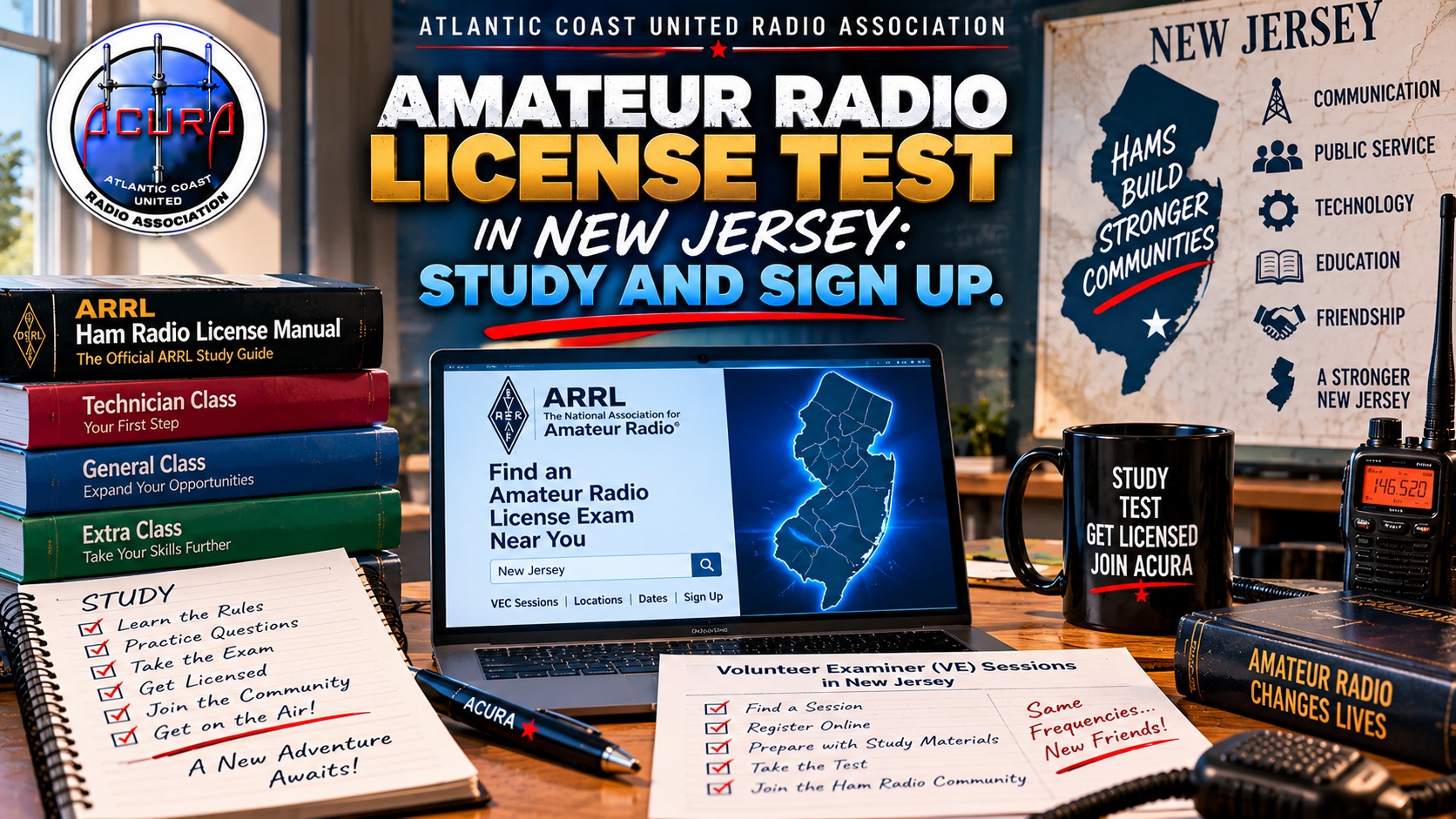
A first amateur radio license test can feel bigger than it is. You may be picturing a room full of seasoned operators, pages of formulas, and rules written in another language. In reality, an amateur radio license test New Jersey candidates take is a friendly, structured step into a hobby built around conversation, practical skills, learning, and community service.
You do not need to own a radio before taking an exam. You do not need an electrical engineering background. And you do not have to arrive already knowing every abbreviation heard on the air. What helps most is a study plan, an understanding of what exam day looks like, and a local group willing to answer the questions that practice websites cannot.
That is exactly what the Atlantic Coast United Radio Association is here for. ACURA has its own Volunteer Examiner team and holds test sessions in Galloway Township, Atlantic County, on the second Tuesday of every month, so when you are ready, you can sign up for your exam right here.
Start With the Technician License
For most newcomers, the FCC Technician class license is the natural starting point. It opens the door to operating on popular local amateur radio bands, including the VHF and UHF bands commonly used with repeaters. A repeater is a radio system that sits in a high location, receives a signal, and retransmits it, helping stations communicate over a much wider area than handheld radios can usually cover on their own.
Technician privileges can lead to casual conversations, public-service activities, portable operating, digital modes, antenna projects, and participation in local nets. A net is simply an organized on-air gathering, often used for check-ins, practice, announcements, or a particular operating interest. It is one of the easiest ways for a new operator to gain confidence after getting licensed.
The Technician exam uses questions from a published FCC question pool. The test has 35 multiple-choice questions, and a passing score requires at least 26 correct answers. That is reassuring for two reasons: you know the topics in advance, and success is about steady preparation rather than trying to guess what will appear.
There are higher license classes, General and Amateur Extra, for operators who want broader privileges, particularly on high-frequency bands that can support longer-distance contacts. Those are worthwhile goals, but there is no prize for rushing past Technician. Many people learn more by getting on the air, joining activities, and discovering which parts of amateur radio hold their interest first. ACURA tests for all three license classes at every session, so you can upgrade with us later without starting the search over.
Important: The Technician Question Pool Changed in 2026
This is the single most common way new candidates waste their study time. The 2026-2030 Technician question pool took effect on July 1, 2026, and runs through June 30, 2030. It contains 409 questions, slightly fewer than the 412 in the previous pool, along with three diagrams used by some of the questions. The NCVEC added roughly 27 questions, removed 30, and reworded about 155.
That means a study book, app, or printed flash-card set built on the older 2022 pool will teach you questions that are no longer on the exam. Before you buy anything or install anything, confirm it says 2026-2030 or valid for exams given July 1, 2026 and later. The current ARRL editions for this pool are the 6th edition of The ARRL Ham Radio License Manual, the 9th edition of ARRL Tech Q&A, and the 11th edition of Gordon West’s Technician Class study guide.
You can always read the official pool for free at the NCVEC question pool page. It is worth checking back occasionally, since the NCVEC publishes errata and withdrawn questions there.
What the Amateur Radio License Test Covers
The questions establish a foundation for safe, capable operating. You will see material on basic regulations, operating practices, radio-wave behavior, electrical safety, simple electronics, antennas, and emergency communications concepts.
Some subjects will probably feel familiar. If you have used a scanner, a GMRS radio, a weather radio, or a Meshtastic node, you may already understand ideas such as line-of-sight coverage, channels, batteries, and signal strength. Amateur radio expands those ideas and adds the operating knowledge needed to use the amateur bands responsibly.
Other topics can sound intimidating at first. Ohm’s law, for example, is a basic relationship among voltage, current, and resistance. You do not need to become a circuit designer to pass the Technician test, but you should be comfortable recognizing straightforward examples and knowing why electrical safety matters.
The regulations section can require careful reading. Rather than memorizing isolated phrases, study the reason behind each rule: amateur radio exists for self-training, technical investigation, communication, and public service, not for running a business or replacing ordinary commercial communications. When the purpose makes sense, the questions become easier to remember.
How to Study for the Amateur Radio License Test
A little regular study beats a frantic weekend of cramming. Begin with the current Technician question pool and a study guide that explains the answers, not just the correct letter. Read a section, take a short practice quiz, then return to missed questions while the topic is still fresh.
For many people, 20 to 30 minutes at a time is enough. The key is repetition. Practice exams are especially useful after you have covered the basics, because they reveal whether you understand the wording as well as the subject. Take several practice tests over a few days rather than trusting one high score on a lucky run.
Free Study Tools That Stay Current
Free and low-cost tools that stay current with the pool include HamStudy.org, which offers practice exams and tracks which topics you have actually mastered, and KB6NU’s No-Nonsense study guides, which are short, plain-English, and free to download. HamStudy is also where you will register for your ACURA exam session, so you may as well get familiar with it early.
Target the Questions You Keep Missing
Pay attention to patterns in the questions you miss. If all your trouble comes from band privileges, make a simple reference sheet. When formulas are the obstacle, work a few examples by hand. If abbreviations blur together, say them aloud and explain them in plain English. Studying becomes more effective when you aim it at the gaps rather than at everything at once.
It also helps to hear amateur radio used in the real world. You may not transmit without a license, but listening is perfectly legal and is a useful way to notice how operators identify themselves, exchange information, and keep conversations clear. ACURA hosts a live web-based SDR receiver you can tune from your browser, with no radio and no license required. Spend a few evenings listening and the vocabulary stops being abstract.
Get Your FRN Before Test Day
This step catches people off guard, and it is the most common reason a VE team has to turn a candidate away.
Before taking an exam, the FCC requires that every candidate have a valid FRN, or FCC Registration Number. It is your login to the FCC’s Universal Licensing System, and the Volunteer Examiner Coordinator must submit your FRN along with your exam results. Registering for one is free, and you can do it entirely online. You cannot take an amateur radio license test in New Jersey, or anywhere else, without one.
Create yours at the FCC CORES site. If you get stuck, the FCC’s FRN help page walks through the form, and Dave Casler’s “Ask Dave” video shows the whole process on screen. Having an FRN also means you will not have to put your Social Security number on any public document. If you have ever held any FCC license, you may already have one.
Do this a week or two before your session, not the night before. Write the number down and bring it with you.
Where to Take Your Amateur Radio License Test in New Jersey
Volunteer Examiners, often called VEs, administer amateur radio exams. These are accredited volunteers who organize sessions, check paperwork, supervise the test, and submit successful results to the VEC. A VE session is not a gatekeeping exercise. The examiners want you to succeed, while still preserving the integrity of the test.
ACURA runs VE testing on the second Tuesday of each month at 6:00 pm, at:
Assumption Regional Catholic School
146 S Pitney Rd, Galloway Township, NJ 08205
The registration link and upcoming dates always appear on our testing schedule page. You register through HamStudy, and we ask that you sign up in advance so the VE team knows to expect you. You do not need to be an ACURA member to test with us, and you do not need to be licensed already. This is where a good number of our members started.
Bring the following to your session:
- Your FCC-issued FRN
- A valid photo ID
- A copy of your current FCC amateur radio license, if you hold one and are upgrading
- Your original CSCE, if you are claiming credit from a previous exam element
- The $15 exam session fee
The VE team will also collect a working phone number and email address, since that is how the FCC will contact you afterward. For a fuller walkthrough of the session itself, see our exam test day page.
Arrive a little early, but do not turn the waiting period into a panic session. A quick review of a few notes is fine. Trying to memorize an entire question pool in the parking lot usually only raises your stress level. You have prepared already; give yourself credit for that.
What Happens After You Pass
Passing your amateur radio license test is a great moment, but there is one more step before you can key a microphone.
Pay the $35 FCC Fee Within Ten Days
Your VE team submits your results to the FCC, and because you passed an exam that will result in a new license, you must pay an application fee, currently $35. The application sits in pending status for ten calendar days while it waits for that payment, and if you miss that window, the FCC dismisses the application. Watch your email, including your spam folder, and pay through CORES as soon as the notice arrives. The fee applies to new licenses, renewals, and vanity call signs, but not to upgrades, so moving from Technician to General later costs you nothing beyond the session fee.
Once you pay the fee, your call sign generally appears in the FCC database within a few days. Your license must be on file before you transmit. Until then, keep listening and get ready for your first contact.
Your First Steps on the Air
When you are licensed, begin simply. Learn how your radio works away from the air: power settings, memory channels, battery care, basic controls. Listen to local activity before keying up. Then make a short, clear call when appropriate. Most operators remember being new, and a polite request for help usually earns encouragement.
A club makes those first steps much easier. ACURA meets on the fourth Tuesday of each month at 6:30 pm at the same Galloway location, and newcomers are welcome whether they are licensed, studying, or just curious. Our New Hams page covers what to do in your first weeks, and you can become a member here. A club can turn a passed exam into practical skills: using a repeater properly, putting up a simple antenna, checking into a net, or understanding how radio fits into community preparedness.
Your Quick-Start Checklist
- Create your free FRN at the FCC CORES site.
- Pick study material labeled for the 2026-2030 Technician pool.
- Study 20 to 30 minutes at a time and track your weak areas.
- Listen to real on-air activity on the ACURA SDR receiver.
- Take practice exams until you are passing comfortably, not barely.
- Register for an ACURA session: second Tuesday of the month, 6:00 pm, Galloway.
- Bring your photo ID, FRN, and the $15 session fee.
- Pay the $35 FCC fee within ten days of the email notice.
- Watch for your call sign, then make that first contact.
Study and Signup Links
- Sign up for your exam with ACURA: Testing Schedule
- What to expect on exam day: Exam Test Day
- Official Technician question pool: NCVEC 2026-2030 pool
- Practice exams and study tracking: HamStudy.org
- Free study guides: KB6NU No-Nonsense guides
- Get your FRN and pay your FCC fee: FCC CORES
- Listen before you transmit: ACURA SDR Receiver
- New to the hobby: New Hams
- Join the club: ACURA Membership
Make the License Useful to You
People earn an amateur license for different reasons. One person wants a hands-on technical hobby. Another wants dependable communications knowledge for storm season or infrastructure disruptions. A family may be looking for a STEM activity that gets young people building, experimenting, and talking with others. A GMRS user may be ready to learn more about repeaters, propagation, and the wider range of amateur-radio modes.
All are good reasons to start. The best next step depends on what you hope to do. If local communication is your priority, focus on repeater operation and local nets. Those who like building things can begin with antennas, power, and simple station projects. If service appeals to you, learn the communication habits that make emergency and public-event traffic orderly and useful.
Treat the exam as a doorway, not a hurdle. Study the material well enough to understand it, sit for the test when you are ready, and then give yourself room to become the kind of operator who helps make local radio welcoming, capable, and ready when the community needs it.
The next ACURA amateur radio license test in New Jersey is the second Tuesday of the month at 6:00 pm in Galloway. Sign up here and we will be glad to see you there.
Leave a Reply