
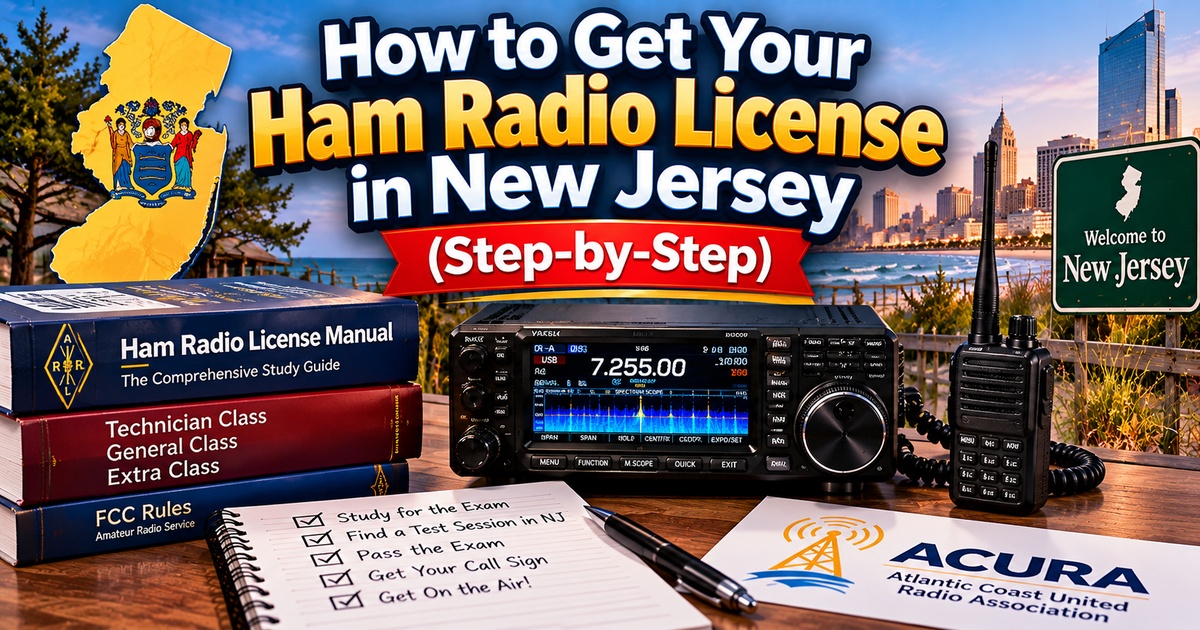
Thousands of people search for how to get a ham radio license every month. The good news is that the process is clear, affordable and very doable. If you live in South Jersey, it is even easier, because you can study, test and get on the air without leaving Atlantic County.
This guide walks you through earning your ham radio license in New Jersey, one step at a time. It covers what the Technician test includes, the free resources that work best, and where to take the exam locally. It also explains how the Atlantic Coast United Radio Association (ACURA) helps newcomers after they pass.
Step 1: Understand the Three Ham Radio License Classes
In the United States, the FCC issues three amateur radio license classes. Each one builds on the one before it.
- Technician. The entry-level license. It gives you full privileges on VHF and UHF, plus some HF privileges.
- General. The upgrade most hams aim for next. It opens large portions of the HF bands for worldwide contacts.
- Amateur Extra. The top license, with access to every amateur frequency.
Almost everyone starts with Technician. You do not need to know Morse code, and you do not need a technical background. In fact, our members include retirees, teachers, students, nurses and truck drivers.
Step 2: Learn What the Technician Test Covers
The Technician exam has 35 multiple-choice questions. To pass, you need at least 26 correct answers. Better still, every question comes from a public question pool, so nothing on the test is a surprise.
The current Technician pool covers topics like these:
- FCC rules and what you may and may not do on the air
- Operating practices, such as how to make a call and use a repeater
- Basic electronics, including voltage, current and resistance
- Radio wave propagation and how signals travel
- Antennas and feed lines
- Station safety, including RF exposure and electrical safety
That list may look long. However, the math is light, and most questions test practical common sense. Many people are ready to pass after two to four weeks of steady study.
Step 3: Study With Free Resources
You do not need to buy an expensive course. Several excellent study tools are free.
Practice Tests and Flash Cards
HamStudy.org is the favorite of many ACURA members. It offers flash cards, practice exams and explanations for each question. Similarly, the ARRL and other sites offer free practice tests that pull from the same pool. Take practice exams until you score in the high 80s consistently. At that point, you are ready.
Videos and Books
Some people learn better by watching. For example, YouTube has full Technician courses from experienced instructors. Others prefer a printed study guide that explains the “why” behind each answer. Either way, combine your reading with regular practice tests.
Study With Others
Studying with a friend or family member keeps you motivated. Also, ask questions at a club meeting. A five-minute explanation from an experienced ham can clear up a topic that confused you for days.
Step 4: Get Your FCC Registration Number (FRN)
Before you test, you need an FCC Registration Number, called an FRN. It is a free ID number that links you to your license. You get it online through the FCC’s CORES system in about ten minutes.
Do this well before exam day. Then, write the number down and bring it with you. Our testing schedule page links to the FCC’s FRN help page and a short video that walks you through it.
Step 5: Take the Ham Radio License Exam in South Jersey
Amateur radio exams are given by Volunteer Examiners, or VEs. These are licensed hams who volunteer their time. ACURA has its own VE team, so you can take your test right here in Galloway Township, Atlantic County.
Our sessions are held on the second Tuesday of each month at 6:00 pm. The remaining 2026 dates are October 13, November 10 and December 8. You can sign up for a session on our testing schedule page.
What to Bring on Test Day
- Your FRN
- A valid photo ID
- A phone number and email address
- A copy of your current license, if you are upgrading
- Any original CSCE certificates, if you want credit for elements already passed
For a closer look at exam day itself, read our post on the amateur radio license test in New Jersey. It explains what to expect in the room, so nothing catches you off guard.
Step 6: Pay the Fee and Receive Your Ham Radio License
After you pass, the VE team submits your paperwork. Next, the FCC emails you a link to pay its $35 application fee. Once the fee is paid, your call sign usually appears in the FCC database within a few days.
As soon as your call sign shows up in the FCC database, you may transmit. There is no paper license to wait for. Your license is good for ten years, and renewal is free.
Step 7: Get on the Air With ACURA
Passing the exam is the beginning, not the end. Many new hams feel nervous about their first transmission. That is perfectly normal. So, the best next step is to join a friendly local net and simply check in.
ACURA holds a weekly club net every Thursday at 7:00 pm Eastern on any of our linked repeaters. For instance, you can use the 147.165 MHz repeater in Egg Harbor with a 91.5 Hz tone. Net control will guide you, and everyone was new once. Our guide on how ham radio nets work shows you exactly what to say.
You will also need a radio, of course. Our guide to the best beginner ham radios in 2026 explains what to buy first without overspending.
Planning Your Next Upgrade
Once you hold a Technician license, the General exam is a natural next goal. It has the same format: 35 questions, with 26 needed to pass. Many hams upgrade within their first year, because General opens the HF bands for coast-to-coast and overseas contacts.
Here is a helpful tip. At most exam sessions, candidates who pass one element may try the next one the same day. Ask our VE team about this when you sign up. So, if you study ahead, you could walk out with a General license on your very first visit. Even if you do not pass the second test, the attempt shows you what to study next.
The Amateur Extra exam is longer, with 50 questions. Nevertheless, plenty of our members have earned it with patient study and help from the club.
Why Get Your Ham Radio License Through a Local Club?
You can study alone and test anywhere. Still, there are real advantages to doing it locally. A club gives you mentors, sometimes called Elmers, who answer questions after the test. It also gives you people to talk to on the air the very first night.
In addition, ACURA celebrates every new operator who tests with us. You can see recent new licensees on our New Hams page. We hope to add your call sign there soon.
Your Ham Radio License in New Jersey Starts Today
Getting your ham radio license in New Jersey takes a few weeks of study, one short exam and a $35 fee. In return, you gain a lifelong hobby, emergency communication skills and a community of friends across South Jersey.
Start with a free practice test tonight. Then, pick an exam date on our testing schedule. If you have questions along the way, contact ACURA. We will be glad to help you take the first step.
Leave a Reply