
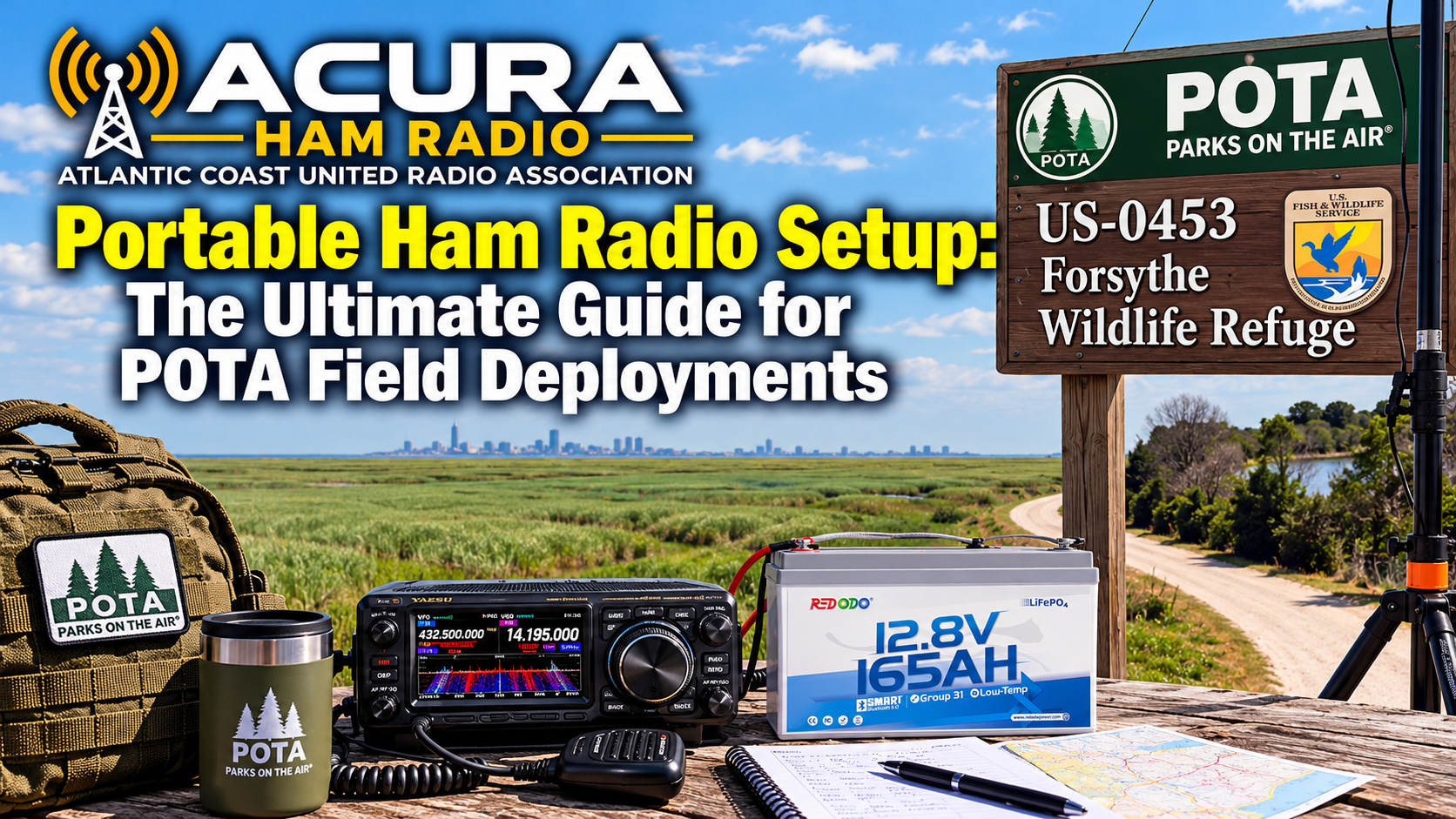
If you’ve spent any time on the bands lately, you’ve heard it: “CQ POTA, CQ POTA.” Parks on the Air has taken off, and I’ve been right there with it. There’s nothing like leaving the home shack behind and putting a signal out from a park, a campsite, or the cab of my truck. Over time, I’ve built a portable ham radio setup that I can trust every time I head out. In this post, I’ll walk you through exactly what I use for my POTA and mobile operations, starting with my Yaesu FTX-1 Optima.
My goal for any portable ham radio setup is simple. It should go up fast and stay reliable. That way, I spend my time making contacts instead of fighting my gear.
My Truck-Mobile Portable Ham Radio Setup for POTA
A lot of my activations happen right from the truck. With a good truck mobile ham radio station, I can pull into a park and get on the air in minutes. Plus, I stay comfortable no matter what the weather is doing.
The Radio: Yaesu FTX-1 Optima
At the heart of my mobile kit is the Yaesu FTX-1 Optima. It’s an all-mode SDR transceiver that covers 160 through 6 meters plus 2 meters and 70 centimeters. In the field, it’s a big deal to work HF contacts and still keep an ear on local repeaters from one radio. The FTX-1 has two independent receivers, so I can do exactly that.
The Optima is really two pieces working together. The first is the FTX-1 Field, a compact radio with its own 6400 mAh battery and a 4.3-inch color touchscreen with a 3D spectrum display. The second is the SPA-1 amplifier, which brings it up to 100 watts on HF and 6 meters and 50 watts on 2 meters and 70 centimeters. The SPA-1 also has a built-in automatic antenna tuner, which is a nice bonus when I’m trying a new antenna in the field. With the optional SCU-66 cable, the radio and amplifier can be mounted apart, which makes it a lot easier to fit into a truck cab.
On top of that, the FTX-1 Optima runs SSB, CW, AM, FM, C4FM, and digital modes like FT8 and FT4. It runs off 13.8 volts from my auxiliary battery and handles long transmit strings without a problem. Best of all, it powers and controls the Yaesu ATAS-120A screwdriver antenna right from the radio. I’ll get to that in a minute.
The Power Backbone: My Redodo 165Ah LiFePO4 Battery
Running 100 watts for hours takes serious power. That’s why I put a Redodo 165Ah LiFePO4 battery right into the truck setup. It keeps my voltage steady above 13 volts through long operating sessions. On top of that, it weighs a fraction of a lead-acid bank and is rated for thousands of charge cycles. When the pileup gets heavy, I don’t have to worry about voltage sag.
The Antenna: Yaesu ATAS-120A Screwdriver
For true mobile work, my go-to is the Yaesu ATAS-120A. It’s a motorized “screwdriver” antenna that tunes itself, and it’s honestly a game changer for quick activations. It can be mounted on a bed rail, bumper, or a heavy-duty mag mount.
Here’s what makes it so nice. When I change bands on the FTX-1 Optima and hit the Tune button, the radio sends a DC control voltage up the coax. That voltage runs the motor inside the ATAS-120A. Then the motor extends or retracts the loading coil until it finds a good SWR match on its own. No getting out of the truck, no manual adjustments.
My Screwdriver Antenna Installation Tips
If you’re planning a screwdriver antenna installation of your own, the most important thing is the ground. Your antenna mount needs a solid electrical bond to the truck’s chassis. The steel frame of the truck acts as your counterpoise. Without a good bond, your SWR will jump all over the place. Take your time on this step; it pays off every single activation.
How I Use My Portable Ham Radio Setup on a POTA Activation
Here’s the routine I follow every time I activate from the truck:
- Check the ground plane. Before I ever leave, I make sure my antenna mount is well bonded to the chassis.
- Park in the right spot. I make sure I’m inside the official boundary of the POTA park. I also pick a clear area away from power lines and low branches that could hit the antenna.
- Tune up. I fire up the FTX-1 Optima and pick my band, usually 20 or 40 meters for daytime contacts. Then I let the ATAS-120A do its thing. I watch for the SWR to drop below 1.5:1.
- Spot and call. First, I spot myself on the POTA network from my phone and find a clear frequency. Next, I start calling “CQ POTA, CQ POTA, this is mobile station activating park number…” Then I get ready for the pileup.
Going Ground-Mounted: My Favorite Portable HF Vertical Antennas
The screwdriver antenna is perfect for quick stops. However, when I’m setting up for a longer stay at a picnic table or campsite, I put up a ground-mounted vertical. A good portable hf vertical antenna gives a lower takeoff angle, which really helps when you’re chasing long-distance contacts.
When it comes to field gear, I rely on two American-made companies: Chameleon Antenna Systems and REZ Antenna Systems. Both build gear that’s rugged, precise, and made for the field.
Chameleon Antenna Systems: Built Like Military Gear
Chameleon Antenna Systems has a reputation for tough, military-grade antennas, and it’s well earned. You’ll see their gear with EMCOMM groups and serious POTA operators who need equipment that won’t quit.
- Chameleon PRV 2.0 (Portable Resonant Vertical): This is one of the best field-tunable HF verticals out there. The heart of it is the MCC 2.0 (Multi-Configuration Coil). It lets you dial in resonance across 40 through 10 meters without an external tuner. It uses a heavy-duty 58-inch stainless steel telescoping whip. Also, you can raise the coil on an extension mast as a center-loaded vertical for better efficiency on the lower bands.
- CHA MPAS 2.0 (Modular Portable Antenna System): This is Chameleon’s do-it-all field kit. With a tuner or coupler, it covers 160 through 6 meters, and it sets up six different ways. There are two vertical setups, plus wire setups like an inverted L, inverted V, sloper and NVIS. The vertical goes up in under five minutes. Best of all, everything packs into one sling bag that weighs under nine pounds, including 50 feet of coax with a built-in RFI choke.
- CHA BV Basic Portable Vertical: If you’d rather keep things simple, the BV is a great choice. It covers 40 through 6 meters using adjustable radiator elements and loading coils. As a result, there’s no wide-range matching network to fuss with.
- Stinger Radial Kit: Chameleon has a clever answer to the radial problem. Instead of long runs of wire, the Stinger kit uses six rigid 48-inch stainless steel radials on a central hub. You get an instant ground plane, which is perfect for rocky ground or tight spots in a park.
REZ Antenna Systems: Precision You Can Feel
If Chameleon is tough tactical gear, REZ Antenna Systems is precision engineering. Their parts are CNC-machined and fit together perfectly. The first time you assemble one, you’ll notice the difference.
- REZ Ranger 80 HF Portable Antenna System: The Ranger 80 is REZ’s flagship, and it’s a fantastic antenna. It handles 200 watts SSB and has a heavy-duty base loading coil built to stand up to the weather. It tunes continuously from 80 meters all the way to 10 meters. Better yet, the slider makes finding resonance smooth and easy.
- REZ Recon 40: The Recon 40 is a compact, CNC-machined HF coil that tunes 40 through 10 meters with REZ’s 17-foot telescoping whip. A built-in bypass switch makes band changes quick. For the higher bands, I just flip the switch and tune the whip. It handles 500 watts SSB and weighs only about a pound and a half. Plus, the built-in radial puck takes up to eight radials.
- Scout XF Portable Combo: When I want to travel light, the Scout XF is a great package. It comes with a modular base, a 25-foot stainless steel telescoping whip, a 40-meter loading coil, a ground spike, and a quick-deploy radial puck.
- [Z]POD Radial Puck and Deployment Gear: REZ’s Quick-Disconnect Radial Pucks and Surveyor Tripods make radial management so much easier. Their FlexPack bag is made of 1000D nylon with hook-and-loop lining and non-slip straps. It keeps my analyzer, coax, and coils protected on the walk into a park.
Quick Comparison: The Antennas I Use
- Yaesu ATAS-120A: Motorized screwdriver antenna covering 40 meters through 70 centimeters, rated at 120 watts, fully automatic tuning controlled by the FTX-1 Optima.
- Chameleon PRV 2.0: Loading-coil vertical, rated at 500 watts SSB, tuned manually with the slider coil.
- CHA MPAS 2.0: Multi-configuration vertical and wire kit covering 160 through 6 meters, rated up to 500 watts SSB, and used with an external tuner or coupler.
- REZ Ranger 80: CNC-machined base-loaded vertical covering 80 through 10 meters, rated at 200 watts SSB, tuned manually with the coil tap and slider.
- REZ Recon 40: CNC-machined coil covering 40 through 10 meters with the 17-foot whip, rated at 500 watts SSB, tuned with a bypass switch and the telescoping whip.
Each one has its place. The ATAS-120A is my choice when I’m staying in the truck. On the other hand, the Chameleon and REZ verticals come out for longer sessions. Any of them is a great rapid deployment antenna for POTA.
My Portable Ham Radio Setup Checklist
Whether it’s a POTA activation or my field day radio configuration, these are the things I never skip:
- Test your power. Before I leave the driveway, I check my battery voltage under a full 100-watt load. I also make sure the terminals are tight. The Redodo 165Ah gives me plenty of cushion, but loose connections can still ruin a day.
- Use an RF choke. I always run a common-mode choke at the antenna feed point, like the Chameleon RFI choke or the REZ CM7. That keeps stray RF from coming back down the coax. Otherwise, it can cause strange radio behavior or a frozen screen.
- Check SWR with an analyzer. I don’t rely only on the radio’s built-in meter. Instead, I keep a small antenna analyzer in my field bag. Then I check SWR right at the base of the vertical before I hook up the main feedline. That one habit has saved me hours of troubleshooting.
If you’re new to the hobby, our New Hams page is a great place to start before you build your first portable ham radio setup. Also, check out our Field Day page to see how the club operates in the field, and browse the ACURA blog for more operating tips.
Get Out There With Your Own Portable Ham Radio Setup
The right Parks on the Air gear makes all the difference. Between the Yaesu FTX-1 Optima and ATAS-120A on the truck and my verticals from Chameleon and REZ, I can activate a park quickly. That means more time doing what I love: working stations. If you’re building your own POTA ham radio kit, I hope my portable ham radio setup gives you a good starting point. I’ll see you on the air, and maybe in a pileup!
William Guerro
W4WAG
Leave a Reply